
Introduction To Film

Maya Deren
Friday, October 11, 2013
Adjusted Outline

Friday, October 4, 2013
Two films related to PERSON assignment
Titicut Follies Frederick Wiseman, 1967

http://www.youtube.com/watch?v=R5FFqWE6NWw
Here I Am Bruce Baille, 1962

http://www.youtube.com/watch?v=v-_H5MQ_VaY
Althought they may prove difficult to watch, these films both represent a commitment to the unsentimental consideration of the lives of others. They address the concept of personhood in a way that demonstrated how what people do can reflect a sometimes completely original way of being.

Norman Rockwell, 1943
Sunday, September 29, 2013
next assignment; PERSON - one minute film. NOT a portrait.
 |
| a dead relative |
A person is a being, such as a human, that has certain capacities or attributes constituting personhood, which in turn is defined differently by different authors in different disciplines, and by different cultures in different times and places. In ancient Rome, the word "persona" (Latin) or "prosopon" (πρόσωπον: Greek) originally referred to the masks worn by actors on stage. The various masks represented the various "personae" in the stage play.[1]
The current concept of person was developed during the Trinitarian and Christological debates of the 4th and 5th centuries in contrast to the word nature.[2] During the theological debates, some'philosophical tools (concepts) were needed so that the debates could be held on common basis to all theological schools. The purpose of the debate was to establish the relation, similarities and differences between the Λóγος/"Verbum" and God. The philosophical concept of person arose, taking the word "prosopon" (πρόσωπον) from the Greek theatre. Therefore, Christus (the Λóγος/"Verbum") and God were defined as different "persons". This concept was applied later to the Holy Ghost, the angels and to all human beings.

Western Philosophy[edit source]
In philosophy, the word "person" may refer to various concepts. According to the "naturalist" epistemological tradition, from Descartes through Locke and Hume, the term may designate any human (or non-human) agent which: (1) possesses continuous consciousness over time; and (2) who is therefore capable of framing representations about the world, formulating plans and acting on them.[7]
According to Charles Taylor, the problem with the naturalist view is that it depends solely on a "performance criterion" to determine what is an agent. Thus, other things (e.g. machines or animals) that exhibit "similarly complex adaptive behaviour" could not be distinguished from persons. Instead, Taylor proposes a significance-based view of personhood:
What is crucial about agents is that things matter to them. We thus cannot simply identify agents by a performance criterion, nor assimilate animals to machines... [likewise] there are matters of significance for human beings which are peculiarly human, and have no analogue with animals.—[8]
Others, such as American Philosopher Francis J. Beckwith, argue that personhood is not linked to function at all, but rather that it is the underlying personal unity of the individual.
What is crucial morally is the being of a person, not his or her functioning. A human person does not come into existence when human function arises, but rather, a human person is an entity who has the natural inherent capacity to give rise to human functions, whether or not those functions are ever attained. …A human person who lacks the ability to think rationally (either because she is too young or she suffers from a disability) is still a human person because of her nature. Consequently, it makes sense to speak of a human being’s lack if and only if she is an actual person.—[9]
Philosopher J. P. Moreland clarifies this point:
It is because an entity has an essence and falls within a natural kind that it can possess a unity of dispositions, capacities, parts and properties at a given time and can maintain identity through change.—[10]
Harry G. Frankfurt writes that, "What philosophers have lately come to accept as analysis of the concept of a person is not actually analysis of that concept at all." He suggests that the concept of a person is intimately connected to free will, and describes the structure of human volitionaccording to first- and second-order desires:
Besides wanting and choosing and being moved to do this or that, [humans] may also want to have (or not to have) certain desires and motives. They are capable of wanting to be different, in their preferences and purposes, from what they are. Many animals appear to have the capacity for what I shall call "first-order desires" or "desires of the first order," which are simply desires to do or not to do one thing or another. No animal other than man, however, appears to have the capacity for reflective self-evaluation that is manifested in the formation of second-order desires.—[11]
The criteria for being a person... are designed to capture those attributes which are the subject of our most humane concern with ourselves and the source of what we regard as most important and most problematical in our lives.—Harry G. Frankfurt
According to Nikolas Kompridis, there might also be an intersubjective, or interpersonal, basis to personhood:
What if personal identity is constituted in, and sustained through, our relations with others, such that were we to erase our relations with our significant others we would also erase the conditions of our self-intelligibility? As it turns out, this erasure... is precisely what is experimentally dramatized in the “science fiction” film, Eternal Sunshine of the Spotless Mind, a far more philosophically sophisticated meditation on personal identity than is found in most of the contemporary literature on the topic.—[13]
Other philosophers have defined persons in different ways. Boethius gives the definition of "person" as "an individual substance of a rational nature" ("Naturæ rationalis individua substantia").[14] Peter Singer defines a “person” as being a conscious, thinking being, which knows that it is a person (self-awareness).[15]
Philosopher Thomas I. White argues that the criteria for a person are as follows: (1) is alive, (2) is aware, (3) feels positive and negative sensations, (4) has emotions, (5) has a sense of self, (6) controls its own behaviour, (7) recognises other persons and treats them appropriately, and (8) has a variety of sophisticated cognitive abilities. While many of White's criteria are somewhat anthropocentric, some animals such as dolphins would still be considered persons.[16] Some animal rights groups have also championed recognition for animals as "persons".[17]
Another approach to personhood, Paradigm Case Formulation, used in Descriptive Psychology and developed by Peter Ossorio, involves the four interrelated concepts of 1) The Individual Person, 2) Deliberate Action, 3) Reality and the Real World, and 4) Language or Verbal Behavior. All four concepts require full articulation for any one of them to be fully intelligible. More specifically, a Person is an individual whose history is, paradigmatically, a history of Deliberate Action in a Dramaturgical pattern. Deliberate Action is a form of behavior in which a person (a) engages in an Intentional Action, (b) is cognizant of that, and (c) has chosen to do that. A person is not always engaged in a deliberate action but has the eligibility to do so. A human being is an individual who is both a person and a specimen of Homo sapiens. Since persons are deliberate actors, they also employ hedonic, prudent, aesthetic and ethical reasons when selecting, choosing or deciding on a course of action. As part of our "social contract" we expect that the normal person can make use of all four of these motivational perspectives. Individual persons will weigh these motives in a manner that reflects their personal characteristics. That life is lived in a “dramaturgical” pattern is to say that people make sense, that their lives have patterns of significance. The paradigm case allows for nonhuman persons, potential persons, nascent persons, manufactured persons, former persons, "deficit case" persons, and "primitive" persons. By using a paradigm case methodology, different observers can point to where they agree and where they disagree about whether an entity qualifies as a person. [18] [19]
American Law[edit source]
A person is recognized by law as such, not because he is human, but because rights and duties are ascribed to him. The person is the legal subject or substance of which the rights and duties are attributes. An individual human being considered to be having such attributes is what lawyers call a "natural person."[20] According to Black's Law Dictionary,[21] a person is:
In general usage, a human being (i.e. natural person), though by statute term may include a firm, labor organizations, partnerships, associations, corporations, legal representatives, trustees, trustees in bankruptcy, or receivers.
As an application of social psychology and other disciplines, phenomena such as the perception and attribution of personhood have been scientifically studied.[22][23] Typical questions addressed in social psychology are the accuracy of attribution, processes of perception and the formation of bias. Various other scientific/medical disciplines address the myriad of issues in the development of personality.
Tuesday, September 17, 2013

Friday, September 13, 2013
Bolex Demonstrations

http://www.youtube.com/watch?v=IKWLJHHy6YA
Tuesday, August 27, 2013
Course Description and Syllabus

Introduction
to Film Making
Ph
299
Ethan
Berry, Instructor
This
course is designed to introduce the student to 16mm filmmaking through hands on
training. It covers the necessary skills needed in the production of a non-sync
film (a film where sound and image are separate elements) from concept to
completion. This includes screenwriting; working with the Bolex or other 16mm
camera; choosing film stock for the project; knowledge of continuity, coverage
and composition; lighting; working with the laboratory; analyzing the success
of the dailies screened in class; logging footage; editing; sound editing; and
preparing the negative or positive for the final print. Students must develop,
write, shoot and edit a short non-sync film outside of class time, using equipment
reserved by the students through school. Students are expected to work together
on each other’s films. Prerequisites: Photographic Media I or Permission of
Instructor Fulfills: Photography Elective (Photography Students), Time-based
Media Elective (Photography Students); Studio Elective
This course is focused
on the basics of filmmaking. The camera, the film material and the construction
of films from that material. The primary point of departure is experimental and
Avant Garde and Experimental film practice from the 1900’s’ until the present.
This practice is relevant because it parallels the development of major ideas
in modernist and post modernist art making.
The medium we will be
exploring is 16mm and to some extent, super-8 film. These materials have had a
robust life in the art world especially in the hands of artists. Film is
tangible and durable, it is rigid and at the same time it is flexible and
responsive to hands on actions.
The camera we use is the
hand wound Bolex camera which can be used with a variety of lenses or none at
all. We will edit the film itself and also transfer it into digital form for
editing with digital editing software.
You will learn about
planning a project, photographing and generating images, organizing those images,
and presenting those images in time. You will reference other films, poetry,
literature, popular culture, photography, writing, sound, dreams, games,
stories and theories. You will make short films (around one to three minutes)
to try out your ideas. You will make one film that is generated from one of
these shorter films and is a further development from it. or expansion on it.
You will often work in
teams trading roles. You will also work by yourself on projects.
We will present the
films you make in real space by projecting them either alone or with other
images and objects. We will look
at and discuss a lot of films by a variety of filmmakers. We will create a
context and a language through which we can talk about these films.
In the end you will have
had a significant encounter with your own ideas, the critical language of film
and the material of the film itself.
Criteria for Credit.
Grade for assignments take into account the degree to which you successfully apply film tools and technology to the
realization of your ideas. The
degree to which you have engaged the idea of the assignment, and the
timely-ness of the completion of your assignments.
You are expected to
complete all of the assignments.
You are expected to be
at every class. (More on this in class)
You are expected to work
between classes (homework).
You will make a
presentation to the class about a film and a filmmaker.
You will be expected to
attend film screening outside of class time.
You will be expected to
contribute to group projects
Emphasis will be placed
on the inventive and creative use of the film medium.
Class participation is
essential since you will be working collaboratively.
Course
outline
Week one Film Viewing -Notes on Marie Menken. Discussion of the camera as a tool.
Week 2
Film Viewing- Stan Brackage Naomi Uman, Gordon Nelson. Discussion; The Handmade Film.
Studio;The
Exquisite Corpse- a group project shot and processed in class.
Week Three Film Viewing, Ernie Gehr, Michael Snow, Tara Nelson, Discussion; The Structural film. Student Film Critique
Studio; Organizing,
Editing and Digitizing Projecting film.
Sound
for film.
Sync.
Sound Demo
Week 4 Film Viewing Maya Deren, Dimitri Kirsanoff.
Paul Turano, Hollis Frampton. Saul Levine.
Studio; Lighting
for film, Studio Project films.
Evening
film showing
Week 5 Film Viewing Student Film Critique. Moholy
Nagy, Hilary Harris, Shirley Clarke. DzigaVerov Discussion; City Symphony
Studio;The Moving Camera,
Camera Supports.
Other
16mm cameras
Week 6 Studio Project Films continued, Film Viewing Bruce
Connor, Naomi Uman, Luther Price. Jody Mack, Discussion; Found Footage, Experimental Animation.
Studio:
Handmade and Found footage Films.
Studio;
found Footage, Handmade Films.
Week 7 Student Film Critique; Found Footage, Handmade
films.
Studio; bleaching, contact printing rephotographing.
Week 8 Final Project proposals due; Titles, text and
copy work.
Copy
stand collaborations, x3
Studio;
Continue collaborations
Group
Portrait Assignment
Week 9 Project meetings, Studio Work.
Studio;
Projects, Collaborations,
Multiple projections.
Presenting
sound
Week 10 Student Film Critique
Studio;
Collaborations
Group
Portrait shoot.
Week 11 Film viewing and Critique
Studio;
Collaborations,
Group
portrait
Final Projects
Week 12 Film Viewing and Critique
Studio;
Portrait
Final
Collab.
Week 13 Last Class presentation
Evening
Film Festival. TBA
Tuesday, April 23, 2013
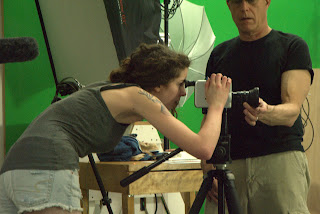
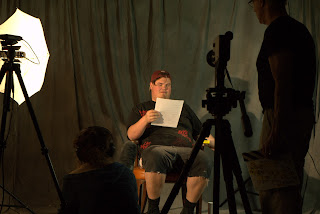
12-Hour, Elevator to Heck, Collaborative portrait shoot.
Stills from our 12 - hour collaborative portrait shoot.






Subscribe to:
Posts (Atom)